A Saturday Health Fair on Woodlawn Ave

April 25, 2012 by · 747 Comments
Filed under: Race, U.S. Healthcare, U.S. Politics 

It’s a long ride on the CTA Green Line from Oak Park to 63rd and Woodlawn Ave where the Mental Health Movement has occupied an unused lot in front of the Woodlawn clinic. I’ve taken that ride several times in the past week or so, most recently on Saturday April 21st for the Mental Health Movement’s day-long health fair. 

The Mental Health Movement is made up of mental health workers, clinic users and their supporters. It has been fighting the closure of 6 mental health clinics in Chicago. Thirty-five people have been arrested so far in the struggle. More about that HERE and HERE. Yesterday, Mayor Rahm Emanuel offered free bus passes to patients of the closed clinics(!) 
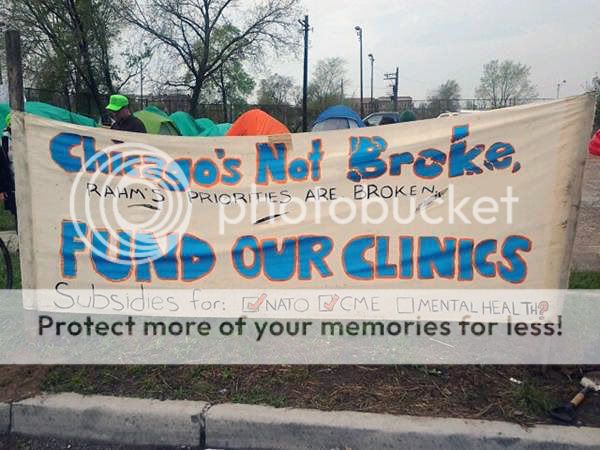
Woodlawn Clinic ProtestPhoto of the original tent encampment

Read more

Occupy Mental Health!

April 16, 2012 by · 42 Comments
Filed under: Society & Economy, U.S. Healthcare 

While riding the El down to the Monday morning press conference by Chicago’s Mental Health Movement, I couldn’t help but reflect on Rahm’s Emanuel’s problems with obsessive-compulsive disorder. He is obsessive about funneling money to Chicago’s wealthy and compulsive about his attacks on services for Chicago’s working class. Rahm’s latest offensive is the closing of 6 mental health centers.  

The issue of closing mental health clinics first came up last fall during the protests surrounding Mayor Emanuel’s proposed budget, which also included slashing library services, privatization of neighborhood health clinics and layoffs of public employees. There was an hours long sit-in outside the Mayors office demanding that all mental health clinics remain open. Below is a video produced shortly after the fall round of protests.

OUR LIVES ON THE LINE: Voices from Chicago’s mental health clinics

Last Thursday night (April 12), a group of patients and mental health workers barricaded themselves inside the Woodlawn Mental Health Center on the South Side to protest its closure. Early the next morning on April 13, police used  tools to break through the door and arrested 23 people who were inside.  

Inside the Woodlawn Clinic before the bust:

Outside of the Clinic before the bust:

Together with with Occupy Chicago, protestors than set up a small tent village outside the clinic to rally support and gain news coverage after months of being ignored. The protests are being led by Southside Together Organizing for Power (STOP), a 5 year old community group. The Mental Health movement is a member of STOP. Occupy Chicago has helped organize people and gather supplies to keep the tent city protest going. The tent city endured a couple of rough nights due to bad weather but is still holding strong. 

WGN TV reports on the tent encampment:

At the Monday morning press conference clinic patients and mental health workers who had been arrested told of not being screened for possible mental health episodes, of having their medication denied to them and being ridiculed by jail personnel. One woman said that she was groped by a male officer in her vaginal area under the guise of being searched, a search that should only be conducted by a female officer. 

There was fear expressed that if clinics are closed, there will be more police brutality toward mental patients, more drug addiction, more self-destructive behavior and more suicides as patients seek help elsewhere, a help that may not be forthcoming as many of these patients are indigent. 

Later the group met with the  officials of the Chicago Department of Public Health (CDPH) who tried to reassure people that their needs would be taken care of by the CDPH “partner institutions”, as well as the remaining public clinics. This was met by deep skepticism by the Mental Health Movement activists who told of people already being turned away after referrals. One woman gave details about the understaffed Greater Lawn Mental Health Center whose workers cried when they had to turn away new patients. 

The term “partner institutions” is just a gussied-up term for privatization, and private health care has no interest in patients that don’t generate a profit.

The Mental Health Movement issued a 23 page report last January with the help of the American Federation of State, County and Municipal Employees (AFSCME). I have quoted from that report below. For the full report, please go HERE

Dumping Responsibility:The Case Against Closing CDPH Mental Health Clinics 

  • The city’s claimed cost savings are tiny and illusory. CDPH claims closing clinics will save $2 million—barely 1% of its $169 million annual budget. And this claim ignores the budgetary, societal and human costs of inevitable disruptions in patient care—including increased emergency room visits, hospitalization, police intervention and incarceration.
  • CDPH should cut waste—including $1.67 million in new spending on upper management salaries, outside contracts, advertising and surveys. This amount should be used to sustain and improve city MH clinics.
  • CDPH would transfer at least 1,100 Medicaid patients to private providers— effectively giving away federal reimbursement for their services. If this plan is budget-driven, it is illogical to turn away patients with the ability to pay.
  • Closing six clinics will force 2,549 patients to travel to other city clinics or seek private care. There is no guarantee that private providers and hospitals will offer treatment regardless of ability to pay. The system’s more than 3,000 uninsured individuals are least likely to find private care since such providers already face shrinking budgets and reduced state funding.
  • CDPH is rushing to close clinics in just eight weeks—despite having six months of funding in the budget and nothing but an outline of a plan for patient care. CDPH has circulated a list of private providers, but admits it has no formal agreements with or information regarding capacity, services and wait times from these agencies.

 As I sat in on the meeting with the Department of Public Health this morning, I thought of my own struggles with depression, of being lost in that long dark tunnel of despair and on at least two occasions, wondering if I was going to come out alive. Fortunately I had access to some limited treatment, even though my health insurance didn’t cover it because it was a pre-existing condition. When people are in that kind of state, it’s difficult for them to fight their inner demons, much less ones with the power of the Mayor’s Office and the LaSalle Street financial barons. My heart goes out to the brave patients of the Woodlawn clinic.

 But despite all of the facts presented and the personal stories told, the Mayor’s obsessive catering to the wealthy and his compulsive dissing of the working class goes on unabated. Mr. Mayor, don’t you think that’s a little crazy?

Faces of Chicago’s Mental Health Movement

Mental Health Movement

Mental Health Movement


Mental Health Movement

Mental Health Movement


Sources consulted: 

Rallying against mayor’s plan to close mental health facilities  by Kaley Fowler

Activists Set Up New Encampment At Clinic In Woodlawn  by aaroncynic

Southside Together Organizing for Power

Politics in Woodlawn: Occupation of the Mental Health Clinic by Ramsin Canon

Protesters Stage Sit-In Of Woodlawn Mental Health Clinic by aaroncynic

Dumping Responsibility: The Case Against Closing CDPH Mental Health Clinics by the Mental Health Movement and AFSCME Council 31


The Time I Was Busted by an Alabama State Trooper——in Maryland?

April 11, 2012 by · 37 Comments
Filed under: Me Stuff, Race, U.S. Politics 

For George Corley Wallace, his 1972 Presidential campaign swing through Maryland was one seriously bad trip. He was met by riots in Hagerstown and Frederick, by loud counter demonstrations at Wheaton Plaza and Capital Plaza near DC and was seriously wounded by  gunfire in Laurel. And me? I managed to get myself arrested by an Alabama state trooper ——in Maryland no less.

Although mostly forgotten now, Wallace was the Halley’s Comet of the neo-confederate universe in the 1960’s, trailing a constellation of stars and bars behind him. As governor of Alabama he stood in front of the schoolhouse door at the University of Alabama in 1962 in an unsuccessful attempt to prevent its desegregation by  black students. 

At his 1963 gubernatorial inauguration he vowed,”Segregation Now. Segregation Tomorrow! Segregation Forever!” When segregation was outlawed by the 1964 Civil Rights Act, he changed his rhetoric to the racial coded language that has inspired generations of Republican politicians from Richard Nixon to Newt Gingrich. Read more

Occupy Transit! Transit Workers and the Occupy Movement Team Up

April 5, 2012 by · 415 Comments
Filed under: Society & Economy, U.S. Politics, Unions 

Calling mass transit “a genuine civil rights issue,” the Amalgamated Transit Union (ATU), which represents transit workers across the nation, joined with the Occupy Movement, community organizations and transit riders to demand a revitalization of our transit systems. Citing such problems as “older vehicles,  deferred maintenance and longer wait times for overcrowded buses and trains,” the ATU was also critical of service cuts and higher fares which have hit working class riders the hardest.

ATU

 ATU national president Larry Hanley was inspired to ally ATU with the Occupy Movement when he learned of a proposal from Occupy Boston for a national day of protest around transit issues. Occupy Boston had issued this statement:

“In Boston and in cities around the country, our hard-won and necessary transportation systems are under attack. Their viability is being threatened by savage cuts and fare hikes in a calculated push toward privatization by corrupt and unresponsive politicians and their corporate benefactors.”

 On April 4, the ATU led demonstrations in 15 American cities to draw attention to today’s transit crisis.

 The ATU wants our mass transit systems to better serve the needs of poor people so that they can get to jobs and enter the mainstream of society. April 4 was the anniversary of Dr. King’s assassination and ATU leaders made a point of calling public transit “a human right” and quoting from Dr King’s speeches. Dr. King began his career as a civil rights leader by leading the Montgomery Bus Boycott which sought public transit  equality for all people.

 In Newark ATU leader Ray Greaves warned that $100 million in planned budget cuts will affect commuters who don’t use public transit because the cuts will put more cars on the road resulting in worse traffic jams as “gas prices are going through the roof.”

 Here in Chicago between 75-100 ATU activists, Occupy Chicago members and transit riders gathered in front of the Chicago Transit Authority headquarters for a scheduled 6pm rally. As the CTA Green Line rumbled overhead every few minutes, ATU members passed out orange “Occupy Transit” T-shirts and signs supporting public transit.

 ATU Member 

ATU International Vice-president Javier Perez(photo below) congratulated CTA workers for the excellent job they did in the 2011 blizzard, something even the Chicago Tribune acknowledged. But as Perez pointed out, the Tribune failed to mention that these were unionized employees. It seems that when unionized employees respond courageously and competently in emergencies, their union status is forgotten.

Javier Perez

Perez went on to criticize the U.S. Congress for its ‘kick the can down the road” attitude toward transit funding. As an example he raised the issue of CTA maintenance employees who are forced to work in rat infested garages. At that point CTA workers raised a chorus of cheers. Perez made it clear that the ATU is tired of politicians and corporate leaders blaming public employees for city budget crises and he strongly stated his opposition to selling off public assets. 

The issue of selling off public assets is a critical issue for Chicago public transit. Recently Mayor Rahm Emanuel announced a massive 7 billion dollar package of infrastructure initiatives that had been largely cobbled together from previous proposals. What alarmed some longtime City Hall observers was Emanuel’s emphasis on “public-private” partnerships which they see as merely a back door method of privatization. Chicagoans are still reeling from the public-private leasing of the city’s parking meters which raised drastically parking rates while enriching Chicago Parking Meters LLC for the next 75 years. The Emanuel proposal includes private-public deals for transit infrastructure upgrades. 

Members of Citizens Taking Action, a CTA riders organization, expressed their opposition to such deals in a leaflet passed out at the Occupy Transit rally. Charles Paddock, secretary of the group was quoted as saying:

”Public transit is a central municipal service, and we don’t put money into a fare box to make some guy rich. I foresee three things happening: loss of control by the city, increased or added fares and diminished service. You might want to add corruption on a scale never seen before. And once it’s done, there’s no going back. Sometimes these deals are for contracts lasting 99 years.” 

A CTA rider makes her views clear

Jan Rodolfo of National Nurses United spoke passionately about how public transit connects us all, how it gets us to our jobs and school, how extended families are often spread across a distance and rely on public transit to come together. It also helps build communities and allows for different communities to connect. 

“Public transportation is no less important than the veins and arteries that bring blood and oxygen to our bodies. And to say that we are going to cut off a neighborhood or a community is like cutting off circulation to a limb and that is totally unacceptable.”

 Jan RolofoJan Rolofo of National Nurses United

 Karen Louis, President of the Chicago Teachers Union echoed Rolofo’s concern about schools and education while pointing out that the thousands of transit workers have children in the Chicago Public Schools and that teachers  and transit workers will always stand together. 

Missing from the April 4 ATU message about public transit was how our dependence upon the automobile is an environmental disaster. Automobile pollution is deadly. A 2008 study done in Southern California showed that car pollution killed more people than car crashes. Public transit takes cars off of the road which makes a huge public health difference. This could improve even more as we move toward sustainable energy generation.  Indeed, sustainable public transit is crucial for limiting the dangers of climate change as well.

 Hopefully ATU members will raise their voices at the upcoming April 22 Earth Day and show how their work is part of a liveable and breathable environment.

ATU Protest

Hey Rahm Emanuel: Libraries Are Sacred Spaces

April 2, 2012 by · 628 Comments
Filed under: Books, Society & Economy, U.S. Politics, Unions 

“I received the fundamentals of my education in school, but that was not enough. My real education, the superstructure, the details, the true architecture, I got out of the public library. For an impoverished child whose family could not afford to buy books, the library was the open door to wonder and achievement, and I can never be sufficiently grateful that I had the wit to charge through that door and make the most of it.” –Isaac Asimov (American author with hundreds of books to his credit)

Probably the best known library of all time was located in Northern Africa. The great library at Alexandria in Egypt was, before its destruction, one of the ancient wonders of Mediterranean civilization. Containing thousands of scrolls, it was the Library of Congress for its day. Its destruction did not come in a single tragic fire, but several, and even historians can’t agree how many fires burned and who set them alight. There was also scroll deterioration plus the inevitable thefts and losses. For the Library of Alexandria, it was death by a thousand cuts.

How much information and imagination was lost? We’ll never know.

For the Chicago Public Library system, its deterioration is proceeding with death by a thousand budget cuts, cuts coming from Mayor Rahm Emanuel’s office on the 5th floor of City Hall, following up on cuts made by his predecessor Hizzoner Richard M. Daley. Libraries are especially important in working class communities where people have less income and where educational opportunities are generally more limited.

Mayor Emanuel doesn’t think that Chicago’s working class deserves a great library system, even though working class people built the city that he  now rules. Rahm comes from the world of Wall Street where one’s worth is measured in stock options, derivatives, credit swaps and margin calls, not the blood, toil, tears, sweat and imagination it takes to build a great city.

Contrary to cheap and degrading media stereotypes, working class people do have an intellectual life and libraries are an important part of that. Adults check out books, take out DVD’s and do research. Kids go to story hours, check out books and do school projects.  Reading makes people smarter, stimulates their imagination and is an important form of recreation.

Libraries serve as community centers where local residents can hold meetings to explore their hobbies, discuss the latest books they are reading and plan social action around community issues. They serve as employment centers for people looking for jobs and for individuals who seek to improve their occupational skills. Libraries also do outreach to schools and other community institutions. They  provide shelter for the homeless.

Here is how one  librarian on Chicago’s impoverished  West Side describes their job:

I was the only librarian on staff in my branch and there were a lot of elementary school students there working on projects. I helped one boy find biographical information on Descartes. He had been looking at an article on Wikipedia and said he couldn’t really understand it. I showed him how to find kid-friendly articles in SIRS Discoverer. Another boy was in with his uncle and grandmother, doing a report on the seven continents. After working with them for a few minutes, I realized that the adults with him couldn’t read. I was able to help him find all the answers he needed in an almanac … I have helped people create resumes, fill out online job applications, find information about health and legal matters, search for jobs and apartments. I have suggested great age-appropriate kids’ books for parents who look around at all the children’s books and don’t know where to begin. As an avid reader, I find it easy to recommend books to adults who are simply looking for something interesting to read. And librarians are doing these same things every day in every neighborhood of Chicago. —from the Go Librarians 

Rahm’s attack on Chicago libraries came down in October of 2011. His cuts included reduction of library hours, the loss of 363 full-time positions, and the closing of libraries on Monday and Friday mornings for a grand total of 10 million dollars in “savings”.

Chicago library users and library workers began organizing immediately. On October 31, protestors gathered in front of the Mayor’s office for a massive story hour accompanied by singing and chants. Some of the parents, library workers and kids were in their Halloween costumes.The group  also delivered a petition to the Mayor.


October library protest
The October 31 story hour and read-in


Stay-at-home mom Amber Cregar put it this way,” There’ll be no more programming for me and my child. It’ll just be a place that warehouses books and computers.”

Megan Russell, a library student, decried the cuts by saying, “The effect will be horrendous for both children and people that cannot afford Internet and cannot afford books.”


The October Mayors Office Protest


Girl Scout Troop 51178 joined the library protests at the West Side Roosevelt Branch  in November, holding their own Occupy-style demonstration outside of the library. Ten year old Girl Scout Charlotte Manier, who hopes to become a fashion designer, said this,”Our library has already cut hours. It would only be open a couple of hours a day if they cut anymore. A lot of kids depend on the library for research. Computers are fine, but they will never completely replace neighborhood libraries.”


Girl Scout Troop 51178
 

These actions were  followed up by January 2012 read-ins outside of branch libraries that were closed on Monday mornings. This action was supported by Occupy Chicago’s Labor Outreach Committee and many community groups. People driving by honked their horns in support. In communities where gang violence has spread fear among residents, libraries are islands of calm, a point that was made by library worker Norma Sotelo who said,”It’s a safe haven for people who don’t have much.”

AFSCME Local 1215, the union that represents the library staff, collected over 500 letters in support of libraries and delivered them to the Mayor’s Office on the morning of March 22, 2012. The Mayor had rescinded some of the worst cuts by then, but that is typical Rahm. He presents an outrageous proposal and then backs off a little to appear reasonable. How reasonable? Well, when a city aide came out to collect the letters, someone asked if the Mayor would actually see them. The aide answered,” Possibly.” Since Rahm does most of his listening to the financial barons of LaSalle Street, this came as no surprise to the assembled workers and their supporters. That’s democracy Chicago-style.

Reading of the Letters
 
 
SEIU supports libraries
Service Employees add their support


The American Federation of State County and Municipal Employees(AFSCME) has been instrumental in the battle to save Chicago’s public library system. Since that union represents Chicago library workers, it obviously wants to save its members’ jobs and improve their working conditions, but there is also a deeper purpose. Most people go into library work because they love reading and have a burning desire to share knowledge and imagination. They are workers on a mission, a mission for reading and study that has been part of the American labor movement since its earliest beginnings.

AFSCME delivers the letters  
City aide receives the letters. He later commented
 that the Mayor might “possibly” look at them 
 

The pre-Civil War American labor movement called for free public education and supported the development of public libraries. Libraries that were designed to teach apprentice and  journeymen mechanics appeared as early as the 1820’s. The National Trades Union newspaper called upon its 1830‘s readers to use their leisure time to read books and to ensure that their families did the same. In 1834, a national trade union convention in NYC demanded the establishment of free public libraries “for the use and benefit of mechanics and workingmen.”

There were avid readers among the female mill workers in New England, one of whom remarked that she had come to work the mills of Lowell MA because of the town’s public library. Sarah Bagley, mill worker and founder of the Lowell Female Labor Reform Association spoke of the reading rooms and lyceums (public lecture halls) that were available. The Lowell Female Labor Reform Association helped lead strikes and campaigns for the 10 hour day in the 1840’s. What good were lyceums and libraries if workers did not have the time and energy to listen and read?

After the abolition of slavery, freed African Americans demanded equal access to education. Slaves were normally prevented from learning to read so this included basic literacy classes. The newly formed Freedman’s Bureau(1865-1870) did its best to provide books and facilities for schools. Along with the efforts of Black Southerners themselves, schooling for black children in the South rose from 10% in 1870 to 40% in 1890. Actual public libraries were rare in the South until the 20th century and once established, were generally segregated.

The Enoch Pratt Free Library in Baltimore, Maryland ( a former slave state), was something of an exception as it was open to all races from its beginning in 1886. The first library designed specifically for African- Americans living under Jim Crow was a 1904 small room in a segregated black school in Henderson, Kentucky. The segregated libraries for Black Southerners were usually not well-funded. It took the 1960′s civil rights movement and multiple sit-ins at all-white Jim Crow libraries before library services became available to all Americans on an equal basis.

The post Civil War period century saw a rapid expansion of public libraries. The National Labor Union called for the establishment of workmen’s lyceums and free reading rooms” in 1866. The Chicago-based Workingman’s Advocate demanded a public library well in advance of  the the 1873  Chicago Public Library opening in an abandoned water tower. The labor movement played a significant role in getting public libraries for such cities as Buffalo NY and Washington DC.

When the fiercely anti-union steel magnate Andrew Carnegie began giving grants for public libraries, it opened up a debate within the 19th century labor movement that showed how libraries were part of the ongoing class conflict between capital and labor. Eugene Debs, the radical leader of the American Railway Union leader decried Carnegie’s efforts, calling them basically a PR stunt to clean up Carnegie’s bad image saying this:

“We want libraries and we will have them in glorious abundance when Capitalism is abolished and workingmen are no longer robbed by the philanthropic pirates of the Carnegie class. . . Then the library will be, as it should be, a noble temple dedicated to culture and symbolizing the virtues of the people”– quoted by Sparane

American Federation of Labor leader Sam Gompers was more welcoming:

“Yes, accept his [Carnegie’s] library, organize the workers, secure better conditions and, particularly, reduction in hours of labor, and then the workers will have the chance and leisure in which to read books” – quoted by Sparane

These differing views showed how libraries became contested terrain. Whose interests were they to serve? It’s true that spokespeople for the upper class  wanted libraries as a form of social control, hoping to avoid the class war they associated with Europe. The American Library Association even published a 1896 article that said:

“Laboring men could not discriminate between their own real interest and such sham reforms as are brought before them by their so-called labor leaders.” – quoted by Sparane

But for labor leaders, libraries were essential to a democratic republic where working class people could gain knowledge and expand their imaginations so they could build a better society for themselves and their children. Librarians became involved  with the  Worker Education Movement of the 1920’s  which sought to do exactly that.  The first library union was started in 1916 at the Library of Congress, but large scale successful unionization of librarians did not begin until the  labor revolts of 1930’s and then really took off with the social upheavals of the 1960’s.

With the protections offered by unionization and civil service rules, librarians are in a better position to resist political attacks and irrational  censorship. They can then ensure that all members of the community have their library needs properly served.

Given today’s ongoing economic crisis, working class people, especially working class people of color, need libraries more than ever. Public education is under constant attack, as corporate interests work to reduce it to a vast rote-learning factory “measured” by testing companies with no real interest in imagination and critical thinking. Colleges and universities are viewed by corporate interests as little more than vocational training centers and product research labs. The increasingly monopolized mass media is well on its way to becoming a shotgun marriage of Big Money and Big Lies.

I’m trying not to sound too dramatic here, but library workers really are on the front-lines against this rising tide of ignorance, mediocrity and mendacity. Some will say that working class people no longer need libraries because they have the Internet. Well I hate to break it to you, but a lot of people are too poor to afford Internet access and broadband Internet connections are scarcer than hens’ teeth in rural areas and small towns. As for e-books, have you looked at the lending restrictions that many publishers slap on them? And what happens when the electricity gets cut off? At least people can read printed books by the light of day.

And guess what, how does one sift through all of those thousands of hits on a Google search? It’s nice to have a trained librarian nearby to help make sense of it all.

OK, so here’s my library story. As a child I lived in segregated working class Glenmont, Maryland until my parents moved to a “better” neighborhood when I hit my teens. It was the 1950‘s: virulent naked racism, social repression, male supremacy, ferocious religiosity, red-scare Cold War politics and a widespread public distrust of intellectuals who were derisively termed “eggheads”.

Every week I rode my bike down the sidewalk of Georgia Avenue toward the Wheaton Library 2 miles away. It wasn’t much to look at, just another dingy storefront in a nondescript suburban shopping strip, but it meant the world to me.

To the left as I entered the library were the science fiction shelves where the books of Robert Heinlein, Arthur C. Clark, Isaac  Asimov, Andre Norton etc. took me on travels through space and time. I met beings from other worlds who made our minor human racial and ethnic differences seem so insignificant. Behind those sturdy wooden shelves were the science and nature books where I learned about evolution, ecology, relativity, atoms, molecules, stars and planets. Nearby was the history section with its Landmark Books: so much human history, so many freedom struggles, so many scientific and technical discoveries, so little time to read about them all. Next to that stretched the regular fiction section with its stories about sports, animals, sailors and adventures in places I could never visit on my bike or even in my parents’ Chevy when they took me on weekend excursions.

That crowded little branch library opened my eyes and mind to possibilities beyond the tract homes of Glenmont and the threadbare airless world of 1950’s  dominant culture with its intolerance and narrow view of humanity.

I later spent 25 years as a teacher in the working class neighborhoods of West Side and South Side Chicago. I know damned well how important libraries were to the students I taught. Many were immigrants or the children of immigrants and like the immigrant Isaac Asimov whom I quoted at the beginning, they had their dreams too.

Obviously some were less enthused about libraries than others, but I think that even those kids who didn’t much like libraries, at least learned to respect their existence and importance. I have yet to see a single Chicago working class person pick up a sign and protest against libraries in their community.

Attacks on libraries are attacks on the minds of hard working decent people. So when Rahm Emanuel goes on the offensive against libraries, he’s getting on “the fightin’ side of me” (to quote Merle Haggard).

Rahm is famous for his incurable public potty mouth, so I’ll send him a message in a language that even he can understand, “Rahm, libraries are sacred spaces. Show some fucking respect.”  

  ALA poll on libraries   

Sources Consulted

Library cuts threaten working class access to culture by Esme Choonara

Public Libraries and Social Class by John Pateman

Library Service to Unions:  A Historical Overview by Elizabeth Hubbard

Overdue Notice: Defend Our Libraries  by  Antonino D’Ambrosio

Library Quotes 

Encyclopedia of African American History Paul Finkelman, editor

Service to the Labor Community: A Pubic Library Perspective by Ann Sparanes

‘There’s a Ripple Effect’: A Chicago Librarian Speaks Out About Cutbacks by Joe M. and Kari Lydersen

Girl Scouts protest library cuts

Letters to Rahm Demand Restoration of Library Hours, Staff By Aaron Krager

Library lovers speak out for Chicago’s public libraries!

Patrons want Chicago library hours fully restored

Restore library hours and staff!

The Public Versus Publishers: How Scholars and Activists are Occupying the Library  by Barbra Fister

How libraries help the unemployed by allpurposeguru